Planning
01
Planning
Group Roles
Aiden [me]: Technical Director, Level Designer & Hard-Surface (Building) Modeler. I have taken the role of these because I have the most experience in Unreal Engine. I will be combining everything together. Adding features to the game via Unreal Engine nodes.
Alex: Environment & Character Modeler (Assets/Props/Models). Alex has taken these roles because he has the most experience in 3D modelling and animating. Alex will model everything including organic models like flowers, trees and rocks, while also modelling the map, characters and mobs.
Kat: Concept Artist & Designer. Kat has the most experience with drawing and concept designing.
02
Planning
Dependencies
Since I am the person who put's all of the assets, props and models together, I cannot start working until the others have completed their work. While I wait for them to work on the models, I can continue researching and planning how I can build the game effectively.
03
Planning
Milestones
For the first two weeks, my plan is to complete my proposals and analysis for the project. Then for week 3 to week 4 I will work on my research. From week 5 onwards, I will work on building the building on blender while waiting for the others to finish their assets. I estimate on week 7 they will finish their assets. By then, I will focus primarily on putting everything together and programming the game together. By week 9, I will be finishing up the project and write my evaluations and what I have learnt in this project.
04
Planning
Game
For the game, I plan to make an introduction for the game's story at the beginning. There will be a group of friends in a post-human looking world. All of a sudden, one of the friends go missing and their jobs are to try find that missing friend. They fight mobs that are robot hybrids to try find the missing friend. Eventually they reach a leader who's the boss that's holding the friend captive. You defeat the boss and rescue your friend.
05
Planning
Concept Art
These are the drawings the concept artist has done for the characters. We are going for an animated low-poly cartoon style for the characters. There will be a group of four characters in total, where one of them goes missing. Each character will follow a similar art style, with different clothing and gear.


06
Planning
Production Planning and Asset Checklist and Gantt Chart
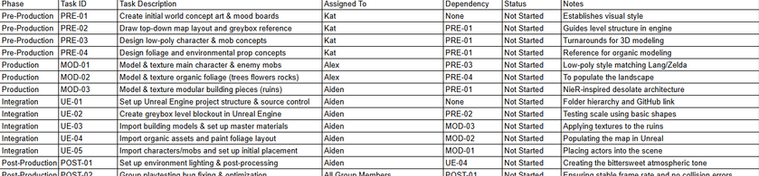
The asset checklist shown above was the main communication tool the group used during the whole of production. The spreadsheet was updated whenever a task moved from one status (Not Started, In Progress or Complete) and shared via google drive so all 3 members could see the sheet at once. The most effective usage of the checklist was during weeks 5-7 where I wanted to know what models were ready to be imported into UE. I did not have to ask Alex and Kat what assets were complete each day as I was able to see the column and know what models were complete. The limitations that came with the checklist were apparent in the production. One limitation was that it was only able to mark assets as complete but there was no ability to mark when the asset was completed, meaning the time difference between planned delivery time and actual delivery time was not visible and also that an asset could be marked complete even if the model wasn't QA passed and needed a lot of work. In the future I would add columns for Planned Delivery Week, Actual Delivery Week, and QA Passed, for greater clarity on when and where issues arose.
These two charts [Gantt and Checklist] were able for me and my team to actively track our progress. Every day, we would check what we have done and see if we were on schedule. We would check the tasks if they were completed. The dependencies helped us with managing consistency, so someone doesn't start something they can't start or finish, which doesn't waste our time.
07
Planning
Risk Assessment
Prior to production, the following risks could have been foreseeable. Here follows each of the aforementioned risks, whether it occurred, and the resultant impact:
Risk 1 - Team dependency bottleneck: All of my integration work in Unreal Engine, as the Technical Director, was dependent on Alex and Kat delivering their assets prior to starting. Should either fail to meet this deadline, my task was blocked. Likelihood: High. Impact: High. This risk did occur - the assets arrived late, shortening my window for integration to weeks 7-9. A mitigation for the future is to build a greybox world usingplaceholdergeometry starting from week 3 so that integration work can begin without needing the final assets.
Risk 2 - Technical complexity of Blender geometry nodes: I had no previous experience with Blender's geometry nodes system, therefore it represented an unknown element. Unfamiliar technical workflows are inherently risky when a deadline looms, due to their unpredictable learning curve. Likelihood: Medium. Impact: High. This risk occurred; the geometry nodes were far more complex than anticipated and ultimately, only the facade geometry was retained to simplify the task. A mitigation for future projects is to run a quick, disposable test of any unfamiliar workflow at the start of week one to establish realistic time expectations before implementing it into the production.
Risk 3 - Collision generation crashing on imported Blender geometry: Calculating physics collision for externally-imported, multipart meshes is computationally intensive, making it one of the riskier technical features to implement in Unreal Engine 5, though this is a fairly common and known risk. Likelihood: Medium. Impact: High. This risk occurred; collision generation caused system crashes across multiple computers. An avoidance for this in the future is to never calculate collision on imported, multipiece objects, and instead generate custom invisible collisions in Blender, or use UE5’s landscaping tools.
Risk 4 - Scope overcommitment in proposal: The original proposal had a boss fight, puzzles, mob enemies, and four distinct characters - all were cut from the project. This represented a significant scoping risk that should have been realized early, during the proposal. An example mitigation for future projects is to implement MoSCoW prioritization on all suggested tasks in the design and to realistically consider the team size during the proposal.